
How to Implement Jev as an AI WhatsApp Bot: From Intent Classification to CRM Loops
A practical architectural guide to building reliable WhatsApp bots by decoupling the deterministic decision-making brain (Jev) from conversational generation (LLMs).
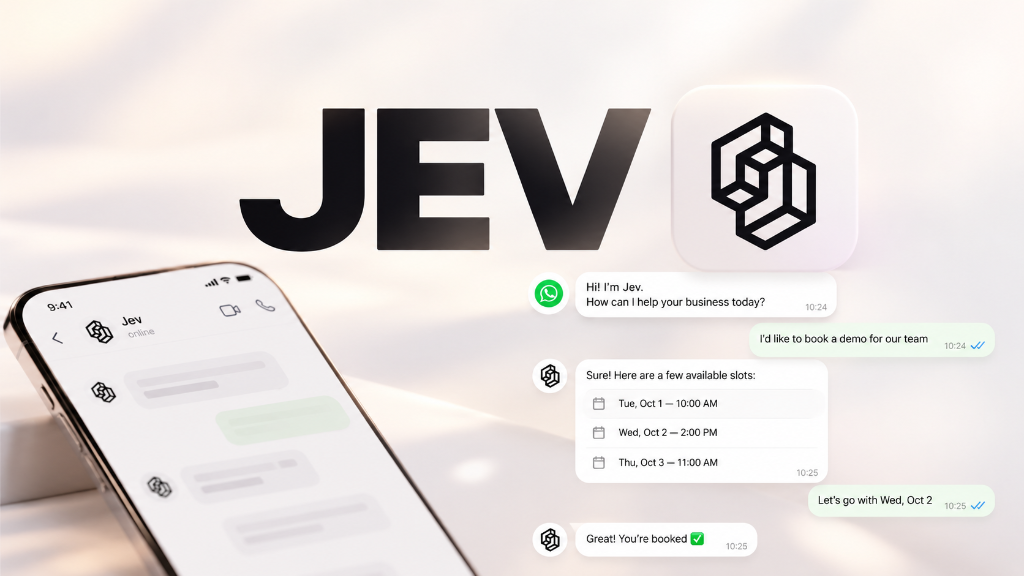
Most attempts to introduce AI into WhatsApp customer operations stumble on a single architectural flaw: treating a raw generative model (like ChatGPT) as a monolithic analyst, dispatcher, and support agent all at once. Teams paste 50 pages of company documentation, pricing tables, and guidelines into a massive system prompt, and then pipe every incoming 'Hello' directly into it.
The failure modes are well known: hallucinated discounts that compromise brand trust, latency (Time to First Token) stretching up to 8–12 seconds, and chaotic, non-deterministic branching when handling real business logic.
The Architecture: Decoupling Decisions from Generation
To build a resilient WhatsApp assistant, we separate deterministic decision-making from conversational phrasing across two distinct layers: Jev as the decision layer, and an LLM as the generative voice.
WhatsApp → Jev (Decision Layer) → CRM & Knowledge Base → LLM (Generation) → Jev (Validation) → WhatsAppHere, Jev acts as the operational brain: it never writes rambling prose. Instead, it inspects context and categorizes incoming requests into structured, discrete outcomes. The generative model (GPT-4o, Claude 3.5 Sonnet) is only invoked downstream with a curated 200-token slice of verified knowledge.
1. Connecting WhatsApp: Official Cloud API vs Gray QR Code
For commercial production, the choice must always be the official WhatsApp Business Platform (Cloud API) hosted by Meta.
Unofficial web-session scraping via QR-code emulators inevitably leads to permanent Meta number bans, WebSocket connection dropouts, and zero regulatory compliance.
The official integration requires a Meta Business Portfolio, a verified WhatsApp Business Account (WABA), and a dedicated business number. Inbound events flow through webhooks:
Client → WhatsApp Cloud API → Webhook Endpoint → Backend (Node.js / Python / n8n)Your backend verifies the cryptographic webhook signature (X-Hub-Signature-256), extracts the message text, sender phone number, and forwards the payload into Jev.
2. Ingesting Messages into Jev: Structured Classification
Suppose a prospect writes: 'Hello, what does setup cost, and can this integrate with our CRM?'
Instead of passing this directly to ChatGPT, we submit it to Jev. Jev evaluates context against predefined enumerations:
Jev responds with a structured, deterministic classification payload:
{
  "intent": "sales",
  "priority": "medium",
  "needs_human": false,
  "customer_stage": "new_lead",
  "confidence": 0.96,
  "entities": {
    "topics": ["pricing", "crm_integration"]
  }
}
Your backend now knows the exact workflow branch to execute without guessing or token waste.
3. Dynamic Context Retrieval: Eliminating Prompt Bloat
Armed with Jev's classification, the orchestrator retrieves only the exact data required for this branch:
By answering 'What does this customer actually need?' first, we feed the LLM a clean, minimal context window.
4. Knowledge Base Integration: Targeted Micro-RAG
Instead of loose vector similarity across an unstructured PDF, Jev directs the retrieval engine to exact metadata tags:
Customer: 'How much does your Business tier cost?'
  ↓
Jev: intent = pricing, product = Business Tier, confidence = 0.98
  ↓
Knowledge Base: extract verified 'pricing_business' block
  ↓
LLM: draft concise, natural answer
This approach prevents pricing hallucinations and ensures verified commercial terms.
5. Generating Responses via LLM: Guardrails and Voice
The generative model receives a laser-focused system prompt:
[System]
Role: AI Assistant at Adina Studio.
Tone: Concise, natural, professional.
Language: Match user query.

[Context]
Customer: New lead.
Intent: Pricing & CRM integration.
Facts:
- Starter: $120/mo.
- Pro: $280/mo (includes CRM integration & webhooks).
- Setup timeline: 1–2 business days.

[Instruction]
Do not invent prices. Answer in 2–3 sentences and ask one gentle qualifying question.
The LLM outputs: 'Hello! Pricing depends on your setup: our Starter tier is $120/mo, while Pro includes full CRM integration and webhooks for $280/mo. Setup takes 1–2 business days. How many team members will be using the system?'
6. Second-Pass Jev: Decision Model for Response Validation
Here lies the architectural superpower: Jev can be applied on the outbound path as well.
The LLM can draft two or three candidate responses:
Jev evaluates the candidates as a decision classifier, selecting the variant with the highest conversion probability and policy alignment:
Customer → WhatsApp → Jev [Intent] → CRM + KB → LLM [3 Drafts] → Jev [Select Best Draft] → WhatsAppBecause Jev operates on bounded choice sets with confidence scoring, it provides rock-solid output filtering.
7. Seamless Human Handoff: Knowing When Not to Automate
Great automation is defined by knowing when to yield to a human specialist:
Meanwhile, routine questions (pricing, FAQs, scheduling, order status) resolve autonomously in seconds.
8. Closing the Loop: Persistent CRM Sync
At dialogue conclusion, the backend updates the client profile in the CRM:
When the prospect returns two weeks later, the bot seamlessly resumes the thread with full historical awareness.
Summary: Enterprise AI vs Naive Chatbots
The paradigm difference is stark: naive chatbots ('WhatsApp → ChatGPT → Reply') are erratic, expensive, and fragile. A layered architecture ('WhatsApp → Jev Decision Layer → CRM/KB → LLM → Jev Validation → WhatsApp') delivers deterministic reliability, predictable costs, sub-second latency, and true production readiness.